
Democracy in America — A Conversation, Part I
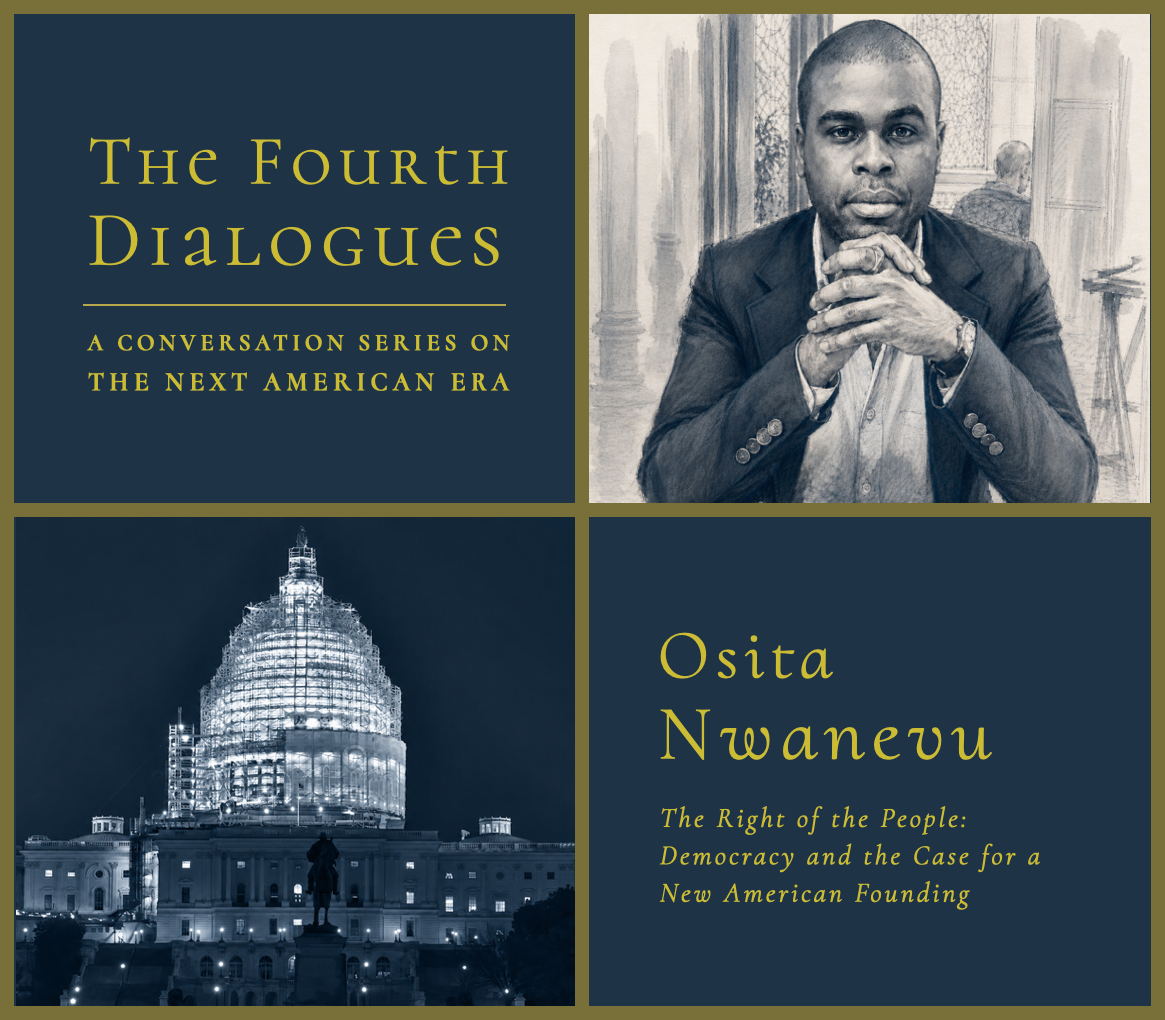
Hey all. Hope you're well. My book touring and promo are just about done at last, and you can expect me back here and elsewhere on other subjects soon. One of my last virtual stops was an interview with The Fourth Founding Project as part of their Fourth Dialogues series on American renewal and "refounding," a concept that's clearly on a few minds and that we'll likely hear more about as the commemorations of America's 250th commence.
This is the first part of that conversation. I’m glad to share it here, and I’ll let the Fourth Founding Project say a bit more about the larger series.
Note from FFP
The Fourth Founding Project is a long-term effort to think through what the next era of American renewal could require: politically, economically, civically, technologically.
We are early in that work. Rather than begin by asking everyone to come to a new platform, we are starting with in-depth conversations published through the channels of the people helping define the terrain. Osita’s work is a natural place to begin.
This conversation is the first installment of The Fourth Dialogues, a series across Substack and beyond with writers, organizers, historians, technologists, and others working through the ideas and conditions for the nation’s next refounding.
We’ll have more to share soon.
Fourth Founding Project: You’re largely done with the book tour. Where are you now, and what are you thinking about?
Osita Nwanevu: There are three main categories of things. The first is that I’ve been ensconced in the world of democratic theory for about four or five years now, through the process of writing and editing the book, and now I’m re-entering the world of actual politics and figuring out what to say there, trying to keep on top of things in a more consistent way. We’re in the middle of a presidential election season that’s going to be ramping up. These underlying questions of where the Democratic Party is going, where the Republican Party is going, I’ll have a lot to say about and think about. My hope is that we see in some of the campaigns a more serious and compelling vision for democracy being offered by Democrats than what we saw in the last election. That might be way too optimistic.
We’re at a very fraught time where most people from the center leftward, and even some center-right conservatives, are really troubled by this administration. The debate about whether Trump can be considered a fascist is functionally over. Whatever we want to say as an academic point, we are seeing an authoritarian presidency. And that means the conversations we’ve been having about democracy at the abstract level, we’re now seeing concretely what it means to lose it, or to see democratic principles and democratic systems get attacked. There has to be a way of talking about democracy that breaks through with people if we’re going to sustain it here. I hope Democrats are serious about talking through what that looks like and how to, beyond fixing the current situation, prevent us from coming to this place again.
The second thing I’ve been thinking about is the 250th anniversary of the founding, coming up this July. We’re going to have a lot of discussion about the trajectory of the country in very broad strokes, where we’ve come from and where we’re going, whether we’re being true to the vision set up by the founders or whether we’ve gone fundamentally astray, how we should understand American history, who ought to be considered American. These are all things that will be up for debate this year. The administration will obviously have its own take, and there can be counters to that. I’m thinking through what this anniversary means, if anything, and whether it can be a jumping-off point for talking about the viability of American democracy.
And then the third thing is AI. We’re in a moment of more profound technological shift than anything we’ve seen in our lifetimes, and our lifetimes have already been suffused with a lot of technological change. The implications of this technology are profound, and the industry itself is telling us it’s going to change our lives and our relationship with ourselves in ways that far outstrip what social media or the internet was able to do. I keep telling people that I’m interested in the project of democracy because it’s deeply tied to the question of what it means to be a human being. The questions we ask ourselves in society, what’s the right way to live, what’s the right form of government, what is justice, all of these sit atop an underlying premise that there is something important about being a human being, something vital about human experience. It’s only after understanding that that you then say, okay, this is the right thing to do with that vital and precious thing, this is the right way to construct society to the benefit of the human being.
It all begins from the premise that the human being is an important thing. And we’re living in a moment where that premise is being challenged by the tech industry and by others who want to suggest there’s nothing significant about us, that we could be replaced by superintelligence that takes on all of our work, and then we might end up being a more sophisticated kind of monkey at the end of the day, and that’s all there is to it. That’s a vision to resist, and it’s a vision underpinning so much of the economic growth and development of this country right now, implicitly. I’m really obsessed with that question, and we need to spend some time over the remainder of the year talking about it.
The word democracy means different things to so many different people. When you use it, what are you actually claiming? What’s the minimum content that has to be there for the word to mean enough?
Osita: This remains, thousands of years on, a deeply contested concept, not just in public discourse but even for people who study democracy and political philosophy. The concept that unites all the different schools of thought is that democracy is a system in which the governed govern. In some form and some design, the people who are governed are the ones doing the governing. It’s not some king, it’s not some alien class of elites or superiors who get to decide what people in a given society do.
That’s the basic concept, and we’ve been trying to instantiate it from forms of what are widely considered more direct or popular democracy, like the Athenian Assembly where all citizens could go and legislate, all the way up through representative democracy as we have it today. Very different systems and very different ways of thinking about what democracy ought to look like. But the idea that unites them is that the people who are being governed are the ones governing.
As best I can tell, there are three main components to any system that ought to be considered democratic in character. The first is equality. Everybody who comes to a democratic choice has to do so in a position of equality, otherwise you leave open the possibility that some class of elites, some privileged minority, winds up making decisions for everybody. The second is responsiveness. Democracy is not the suggestion box. People come together and act democratically, and things happen. A democratic system is obligated to respond to the democratic actions of the governing public. The third is majority rule. Of all the different ways we might make a collective choice together, from unanimous agreement down to minority rule, majority rule is the only decision rule that respects the equality of each participant. If two people want something and three people want another thing, it’s very hard for the two to get their way over the three unless there’s some fundamental underlying inequality involved.
So we’re bound to some kind of majority rule being in place in any real democracy. All of that gets vastly more complicated, especially majority rule. But those are the basic components you have to look at when you evaluate whether a system is democratic in character. My book was dedicated to the task of evaluating whether the United States meets those standards. There are no perfect democracies. I don’t think there’s a system that perfectly instantiates all of these principles to everybody’s satisfaction and against every possible theoretical objection. But there are systems that are better and worse than others on these grounds. The United States could be much better.
Your book argues that the American founding was not only incomplete on the democratic front but built on clear anti-democratic grounds. How contested is that claim today among those who study this, and would you say America has never been a democracy, or never been a true democracy?
Osita: I’m making the strong version of the claim, which is that America has never been a democracy. People try to work through this question by doing a kind of dance between our aspirations and historical realities that everyone in academia recognizes and accepts. Right off the bat, when you ask most Americans today what they consider democracy to be, you get this idea where everybody has the right to vote and it’s not restricted on the basis of race or gender or wealth. Nobody at the founding believed this. That vision of democracy is absolutely and obviously not the vision the founders believed they were instantiating in 1787. Women couldn’t vote. Enslaved people had no rights. That historical fact really weighs on people, because it’s very hard to talk about the society created by the Constitution initially as a democracy without straining the word beyond meaning. How could you be a democracy if half the population doesn’t have any political rights, if you have a subjugated class of people in many cases prevented from being able to read and write? You’re just talking about something else.
There’s a tendency, even in academia, because there were important things about the founding and the groundwork it laid for a more democratic society, to gloss over those things as though they don’t really matter. Well, it was a democracy if you consider only white men. But even then, there were property requirements. If it’s a democracy restricted to a class of propertied white men who govern an entire society of people not like them, then it’s not a democracy at all. I don’t know how you get around that logically.
The thing that’s been most interesting for me to probe is that even leaving slavery aside, leaving the status of women aside, leaving Native Americans aside, and just considering the population of people who would have been given political rights at the time of the founding, the founders were very, very skeptical about the wisdom of giving even that restricted class of Americans democratic political rights, and sought very explicitly to constrain their ability to act democratically and to constrain mass politics.
I don’t think this is that contested. I’ve drawn a lot from the work of Michael Klarman at Harvard Law, who wrote a wonderful book called The Framers’ Coup. Sanford Levinson has been saying versions of this for a long time. There’s a tendency to taper over or minimize these things for the purposes of public writing, but the historical record is what it is. I’m quoting in my book speeches that Madison is writing down in Philadelphia at the convention in 1787, where people like Edmund Randolph were saying, well, we’re here because the state constitutions have been too democratic in character and we need to create a governance structure that empowers a federal government that will be sovereign and also less democratically accessible. There are versions of this being said all throughout the convention. We have the letters from the founders. We know exactly what they think. It’s not subject to speculation. We know exactly what they’re going for and exactly how they framed it.
One of the difficulties here is that the word democracy has a tortured history, and there are times when people seem to be referring to democracy in those notes and letters and speeches, but they’re not talking about democracy in the way you and I take it for granted today. Nobody on either side of the question, whether more willing to give the public a little or more fearful about popular opinion and democratic rights, is thinking that democracy in a defensible form is the kind of democracy they want to create in America. Nobody. That’s just the historical record.
One of the things I’m wrestling with in the way the book is framed is the whole history of using the founding, the Declaration, and the Constitution as inspirational material. There have been all kinds of great Americans, Frederick Douglass most famously, who have utilized some of the rhetoric and ideas expressed by the founders for the project of expanding democratic rights and freedoms in this country. That’s an extremely important rhetorical, political, and organizing tradition. I’m not writing that any of that was wrongheaded or mistaken, at least at the level of political action. But because that tradition exists and because it is one of the primary ways of generating change in this country, people are very reluctant to take a critical eye toward the founding, out of a fear that if we abandon that view of America as being a constant rewrite of founding documents where all the principles are just there and we just have to interpret them, we’d be left with nothing, with no engine for generating positive change.
That doesn’t have to be true. Taking the critical eye toward the Constitution that I offer in this book is not to say there isn’t an American history we can draw from, learn from, and build upon, or that there isn’t an American project worth pursuing and crafting. I just don’t think the Constitution or the intentions of the founders have to be the binding material for that mission or the grounds upon which it stands. That’s a difficult mode to argue for. It’s so different from the way people are used to thinking about our history. But for that reason, people who know what Edmund Randolph said at the beginning of the constitutional convention and have read the same material I have have nonetheless been reluctant to follow that material to a negative-sounding conclusion about what the founders were after, out of fear that it disillusions us in ways that might be politically counterproductive. That doesn’t have to be the case.
What does it mean to you to call for a new American founding? And connected to that: France numbers its republics; they’re on their fifth since 1789, and yet America has generally not thought of itself in terms of numbered foundings or republics. Why do you think that difference exists?
Osita: I wish I knew why. The French have had so much internal strife that they might be bound to think about their history that way, but it’s not like we haven’t had that. We famously had a Civil War which created a really different society at the end of it. So I don’t really know the historical why. But I value and appreciate the work people like Eric Foner have done, at least within the academic community, to mark out these different points at which we reformed our institutions in ways that really did transform America. He writes about the second founding. There are people who think we’ve had three, or two, or however many. I can’t speak with any authority about just how many or how to mark those lines out. But I am arguing in this book that we need a grand transformation of that kind again, of the kind that we had after Reconstruction, to solve the problems we’re facing as a country today and to reform our institutions in the interest of creating a more real democracy.
For me that’s not a transformation that has to happen in one grand moment or through a constitutional convention that ought to happen next year. It’s more a gradual process of change. In any of the foundings we’ve had, there are laws or amendments passed, and even then it still takes a long time for those things to get instantiated or fully enacted. It’s probably a mistake to think about foundings as single moments as much as gradual eras of change. That’s what I’m arguing for here.
Accepting the thesis that we have never been a true democratic republic, what does the agenda look like? What needs to get done?
Osita: There’s a very long-horizon answer and a more concrete one. On the long horizon, at some point the Constitution needs to be replaced. Not in the next year or five years. There’s all this talk now about an Article 5 convention that the right has actually taken more initiative on than progressives have. I don’t think that process would end well or democratically if it happened tomorrow. There’s a lot of work we need to do in thinking through how we might reform things, experiments we need to run, debates we need to have, and people need to be organized and prompted into thinking about these questions rather than having a convention sprung upon them before there’s been a large national conversation.
The long horizon is maybe by century’s end we come together and have a different governing document. Our Constitution is 237 or 238 years old. The average lifespan for a written constitution in the developed world is about 31 or 32 years. We’re way out of whack. Countries do decide peaceably, every so often, that they just need a different set of arrangements. Sweden did this in the last couple of decades. That’s plausible to me as something we can work toward in the very long term. And I hope that by the time we get to that point, we will have already substantially democratized American society, and the Constitution and the idea of having a new one is just the cherry on top of a process of democratization that’s been going on for many decades.
Between now and then there’s a lot we could do to democratize the system short of a full-scale constitutional convention. I talk about reforming the Senate. It has gotten to a place where it structurally advantages certain parts of the country more than others. One way to address this is adding new states from underrepresented populations to balance things out. People have also talked about maybe converting the Senate into a kind of house of lords structure, where it’s still there but most of the legislative functions have been given over to the House.
But as far as the political agenda I would prioritize given our current situation, the main reforms I focus on start with the filibuster in the Senate. That’s not something that needs a constitutional convention or even a piece of legislation. A majority in the Senate can decide at any time that they want the Senate to go back to its original design, which is a majority-rule institution, where if you have more votes than the other side you can pass a law. The fact that it takes 60 votes to get any ordinary piece of legislation through the Senate has fundamentally deranged and distorted American politics.
If Trump got his way and removed the filibuster, would you be okay with that?
Osita: I would be, and that would be an improvement. The difficulty people have here is sort of the reality that other people win elections, which is something you have to accept in a democracy. If we had a filibuster-free Senate, yes, you would get situations where Republicans could pass laws I would oppose that would have negative impacts. That is the price of living in a democracy, having the ability to govern yourself and to contest free and fair elections. You have to be willing to accept that if you’re committed to democracy in principle. And this is one of the reasons why conversations about the why are so vital and so important, because you discover very quickly when people are confronted with things like this how contingent their support for democracy actually is.
I remember reading, in the wake of the 2024 election, articles about conversations being had within Democratic advocacy groups about whether they’d made a mistake in recent years trying to register so many people to vote or turn out low-propensity voters, given that so many of those voters actually tilted toward Donald Trump. For me, no, it was not a mistake. If you believe in democracy, it wasn’t. If you believe we have the right to make political decisions for ourselves in fair majoritarian competition with others, you’re committed to getting as many people into that process as possible. And if you have a particular political ideology, as I do, you then make the arguments that win people over to your side. You do not depend on hurdles like the inaccessibility of the vote or the Senate filibuster to instantiate the world you want, because they break politics and make it unsuitable for democratic governance.
The filibuster as a bulwark against bad things happening, one, does not prevent bad things from happening. That’s clear in the current situation. And two, you can’t break all of politics out of a fear that you might lose out on a given political question. That’s not a sensible way to go about things. One of the things Adam Jentleson makes clear in Kill Switch is that the fact that Congress cannot actually pass legislation has empowered the executive to an extraordinary degree. People now try to make policy through the White House, through executive actions, through administrative decisions, and also through the judiciary, in ways that should terrify people who are afraid of authoritarianism, because if all that power is vested in one person because Congress can’t get things done, that puts you in a very bad situation. We’re seeing the consequences of that right now in this administration.
There are so many distortions and malignancies that the filibuster creates. I’m fully willing to swallow the reality that in a democracy people who disagree with me will win, and I’m willing to swallow that to have a democracy, because the alternatives are just horrible. And as a practical matter: if Republicans believed they would get the lion’s share of the benefit from limiting the filibuster, they would have done it already. There’s a reason why John Thune has been telling Trump as many times as he can that this would be a bad idea for the right, because it would be. The filibuster is overwhelmingly a guardian of the status quo in a way that helps conservatives. As Jonathan Chait explained really well in a piece a few years ago, if you’re on the side of American politics that wants big new programs or new regulations, it’s very hard to do that any other way but through novel legislation that the filibuster then inhibits. But if you’re on the side that wants to prevent government from doing things and deregulate, making it harder to legislate is actually to your benefit. Republicans have much more of an interest in preserving the filibuster than Democrats do. In pure democratic terms, it has to go.
I would also talk about the addition of new states. In democratic terms, it is unacceptable that we have 4 million people in this country who do not have a full say in their own federal government. They have representatives who can participate in floor debates, but they can’t pass a meaningful vote on final passage of legislation. That’s wrong. DC has made its preference for statehood very clear over many decades. Puerto Rico and the territories are more complicated, but they should be given referendums where they decide what they want their status in relation to this country to be.
And then the judiciary. We have a very unusual Supreme Court, not so much in the fact of judicial review, which has other precedents, but in the composition of the court and the fact that people are there for life. This distorts politics enormously. If you know a vacancy on the Supreme Court will be filled by somebody who’s going to be there for the rest of their lives, maybe many many decades, you do anything to get your person on that court. The Biden administration did convene a commission to talk about this, and they came up with some recommendations that didn’t go anywhere. The specific recommendations are harder to come up with because there’s this tension between wanting full democracy while recognizing that majority rule can lead to negative outcomes for minorities and marginalized people. What we tend to assume in liberal democracies is that there ought to be some kind of body with the power to review or overturn certain decisions on the basis of rights and principles. It’s right to have that kind of body, but it’s a question of how it’s designed. Term limits for justices and figuring out how to rotate them from lower benches are reforms worth considering.
And the Electoral College, which I sometimes forget about because I think it’s the thing I need to make the fewest arguments about. Most Americans for decades have thought the Electoral College is a kind of insane system, and they’re right. But there is an effort called the National Popular Vote Interstate Compact that would offer a means of getting around it without a constitutional amendment, which is functionally impossible. Virginia just became a signatory recently. What the compact does is commit states, once they join, to giving their electoral votes to the winner of the national popular vote. Once states with a total of 270 electoral votes between them have done this, the winner of the national popular vote automatically gets to 270, and you’ve basically obviated the Electoral College in its original design and moved to a popular vote system. That’s an effort worth continuing. I can see it getting done within the next decade, or decade and a half. The fact that we have a political system where your vote only really matters if you happen to live in a particular place, and those are the only people presidential candidates really address themselves to or even visit, that’s not good. It distorts politics in all kinds of ways. It’s anti-democratic, and it’s long past time to move on.
The book also makes the case that we ought to be thinking about reforms to our economy, both for practical reasons and on democratic grounds. We just saw last year the wealthiest person on the planet buy his way into a position on the executive branch where he got to rework it to his liking and fire people because he happened to be rich and happened to have the money to donate to Donald Trump’s campaign. Those aren’t conditions in which you can expect a democratic society to exist and thrive. Inequality is a threat beyond its already bad material consequences. It’s a threat to self-governance and political equality.
And on democratic grounds, we are entitled to a measure of agency within the economy that we’re not being given. We spend about a third of our lives at work. The decisions that are made at work often affect us more directly, intimately, and immediately than decisions made in Washington DC or a state house or at city hall. And yet we take it for granted that this doesn’t give us any democratic rights. Somebody who works at Amazon can go to the polls and vote for what they think our foreign policy ought to be with respect to Iran. That’s absolutely right. But there’s no place where they get to say how they think Amazon ought to be run, even though they’re generating the wealth the company produces and it shapes their life in all kinds of ways. That’s a democratic problem.
The American worker is being squeezed more and more and given fewer and fewer rights. The labor movement has been eroded over the last few decades. I talk about reviving the labor movement, but also things like codetermination, which is the election of seats on corporate boards by workers. I talk about cooperatives and different models of having workers take up a greater share of the ownership of major firms, giving them both voting rights and a measure of the wealth they’re producing. All of those have to be considered democratic ideas, in conversation with our existing discourse about political democracy. If you hate authoritarianism in Washington DC, you should also be troubled by authoritarianism in the very structure of our lives, where people have a tremendous amount of unaccountable power to treat workers quite unfairly without much recourse.
Getting to a point where we can implement some of these political changes will mean empowering ordinary people within the economy, so that they have the resources to say, this company is not going to intervene in the democratic system. And being part of a union or a worker structure of some kind teaches you how to compromise with people, make arguments, organize, appreciate difference and work through difference. All of those are important skills for democracy. What if those were skills you were developing on a more regular basis through work? It would be tremendously beneficial to the health of democracy.
That’s the menu. Those few political changes, and then more broadly beginning with the PRO Act, which is the package of legislation that would make it easier to organize and would deal with state right-to-work laws. That’s the democratic agenda I’d hope people pursue over the next decade.

Nwanevu. Newsletter
Join the newsletter to receive the latest updates in your inbox.